Forget chatbots that answer questions. In 2026, AI agents plan, decide, and take action on your behalf — booking meetings, managing finances, fixing bugs, and running entire workflows without you lifting a finger. Here's what's actually happening, and why it matters for everyone.
The Era of Simple Prompts Is Over
For the past three years, most people experienced AI as a conversation. You type a question. The AI answers. You copy, paste, and move on.
That era is ending. In 2026, AI is evolving from conversational systems into operational software. Instead of simply answering prompts, AI agents can now operate across tools, systems, and workflows inside real business environments. CNBC
AI agents are no longer an experimental side project inside enterprises — they are quickly becoming part of the core operating fabric. The question is no longer whether this shift will happen. It already has. Tech Journal
So What Exactly Is an AI Agent?
A regular AI answers your question. An AI agent completes your goal.
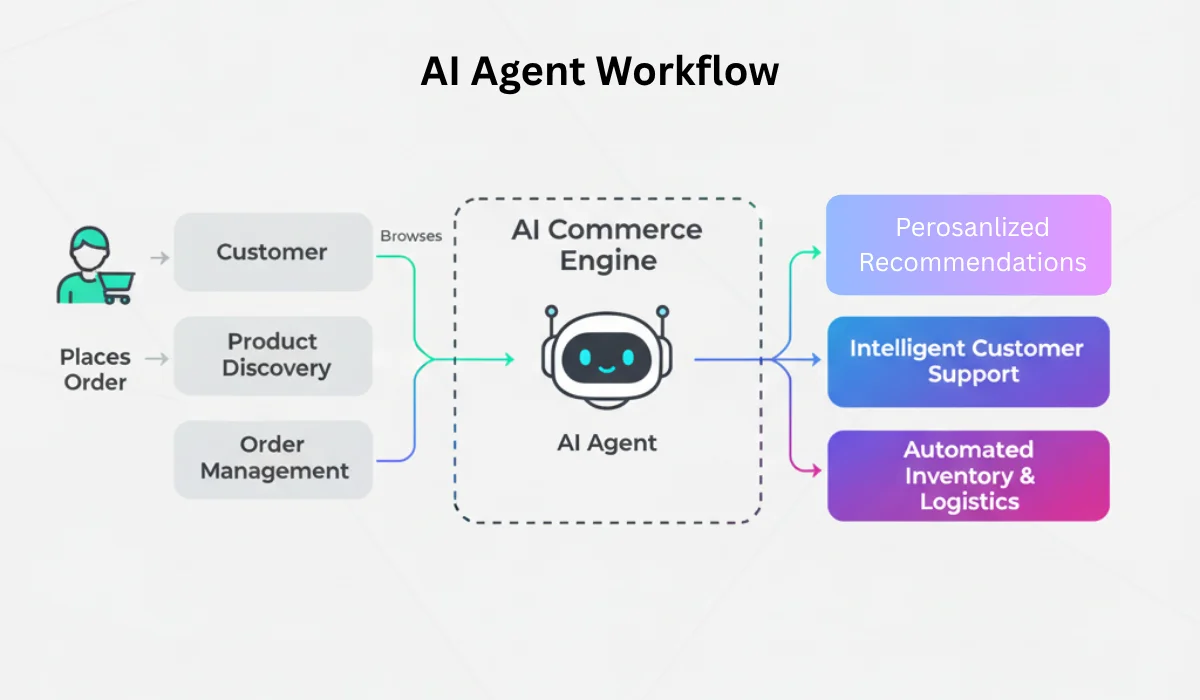
An AI agent is a system that combines advanced AI intelligence with the ability to use tools and take actions on your behalf. Unlike traditional AI that might just summarize a document, an agent understands the goal, creates a plan, and executes multi-step tasks across different applications — all under human oversight. Tech Journal
Here's a simple example. Instead of asking ChatGPT "what should I reply to this email?" — an AI agent reads the email, drafts a reply, checks your calendar, schedules the meeting the email requested, and sends a confirmation. All from one instruction.
The Numbers Behind the Shift
Industry analysts project the agentic AI market will surge from $7.8 billion today to over $52 billion by 2030, while Gartner predicts that 40% of enterprise applications will embed AI agents by the end of 2026, up from less than 5% in 2025. Council on Foreign Relations
IDC expects AI copilots to be embedded in nearly 80% of enterprise workplace applications by the end of 2026. That is a transformation happening at a speed rarely seen in enterprise technology. Orrick
How AI Agents Actually Work
The key difference between a chatbot and an agent comes down to three capabilities:
1. Planning Rather than responding to a single prompt, modern agents can plan actions, sequence tasks, and execute workflows across multiple systems. Earlier AI systems were mostly reactive — they could answer questions or generate content, but they struggled when a task required planning, iteration, or coordination across different tools. CNBC
2. Memory Research on modern AI memory architectures shows accuracy improvements of around 26% while reducing latency and token costs. In practice, this allows agents to remember past interactions, resume workflows where they stopped, and make decisions using historical context instead of treating every request as a new problem. CNBC
3. Tool Use Agents can connect to your email, calendar, browser, code editor, databases, and third-party apps. They don't just generate text — they take real actions in real systems.
Real-World Examples Right Now
In telecommunications, agents can now autonomously detect network anomalies, open a field service ticket, and alert the customer — all in one integrated sequence. Tech Journal
In logistics, if a delivery van breaks down, an agent can automatically reschedule the delivery, apply a service credit to the customer's account, and notify them via text with a new time slot — before the customer even realizes there is a delay. Tech Journal
In financial services, agents notice issues, temporarily stop suspicious payments, and adjust investment portfolios based on market changes. Lawandtheworkplace
And in software development, AI coding agents like GitHub Copilot Workspace can now take a bug report, write a fix, run the tests, and open a pull request — without a human touching the code.
Multi-Agent Systems: AI Teams Working Together
The next frontier is not one agent working alone. It's multiple specialized agents collaborating.
Single-agent workflows are rapidly being replaced by collaborative multi-agent ecosystems. By dividing complex processes among multiple specialized agents, organizations can achieve higher accuracy and prevent the "hallucinations" common in single-model setups. Wikipedia
In 2026, business value grows by creating "digital assembly lines" — human-guided, multi-step workflows where multiple agents run a process from start to finish. This is made possible by the Model Context Protocol (MCP), a standard that allows agents to connect seamlessly with diverse data sources and take real-time actions. Tech Journal
Think of it as an AI department, not just an AI assistant.
What This Means for Everyday Users
You don't need to work at a Fortune 500 company to benefit. AI agents are already available to individuals through tools like:
- ChatGPT Tasks — Sets reminders and executes recurring actions automatically
- Claude Projects — Maintains memory and context across long workflows
- Google Gemini with Workspace — Manages emails, documents, and meetings
- Perplexity AI — Researches topics autonomously and synthesizes findings
- Zapier AI Agents — Connects your apps and automates workflows without code
The common thread: you describe a goal, and the agent figures out the steps.
The Human Role Is Not Disappearing — It's Shifting
As AI agents become more autonomous, the role of humans is not disappearing — it is shifting. Instead of managing every step, people increasingly oversee how agents operate, especially when decisions carry operational or financial risk. Many organizations are already putting guardrails in place. The goal is not to slow automation down but to keep it observable and accountable. CNBC
This is the most important thing to understand about AI agents in 2026. They are not replacing human judgment — they are taking over the execution, so humans can focus on the decisions that actually matter.
The Risks Nobody Is Talking About Enough
Agent autonomy creates new accountability questions. If an AI agent sends a wrong email, makes a bad financial trade, or deletes the wrong file — who is responsible?
With autonomous agents executing real-world transactions and accessing sensitive databases, governance has become a top priority. In 2026, leading platforms are incorporating advanced security frameworks to provide real-time monitoring, data masking, and full audit trails. Wikipedia
Organizations that deploy agents without the right governance foundation risk an ineffective initiative that goes over budget and underdelivers. Being "AI ready" means having the right structures in place before implementing AI technology. Paul Hastings LLP
Bottom Line
AI workers aren't coming — they're already here. And they aren't just assistants anymore. Agentic AI is reshaping the state of AI faster than anyone predicted. Paul Hastings LLP
The shift from "AI that answers" to "AI that acts" is the defining technology story of 2026. Whether you are a business owner, a developer, or simply someone trying to stay informed, understanding AI agents is no longer optional. It is the literacy of the next decade.
Published on ai4u.pro — June 5, 2026 · 9 min read