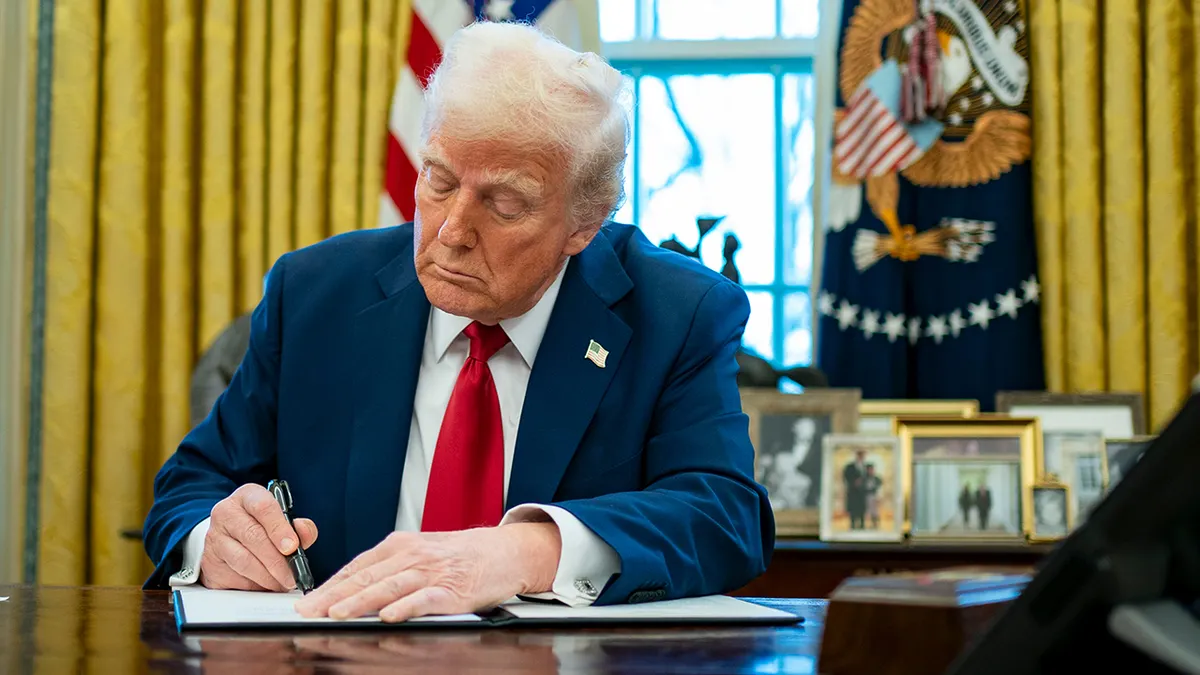
On June 2, 2026, President Trump signed the most significant federal AI policy since taking office. Between cybersecurity mandates, frontier model rules, and criminal enforcement, this order reshapes how the US government — and AI companies — will operate. Here's the full breakdown.
A Turning Point in US AI Policy
President Trump signed a long-awaited executive order on AI on June 2, 2026, titled "Promoting Advanced Artificial Intelligence Innovation and Security," marking a shift by the administration toward federal oversight of AI. Electronicsmedia
This is the most detailed federal AI policy action since Trump revoked the Biden administration's AI safety order in January 2025. The order explicitly positions the US as the global AI leader while establishing new security frameworks for frontier AI models, directing law enforcement to prosecute criminal use of AI, and expanding the cybersecurity workforce. Aotrading
The timing is not accidental. This order lands at a moment when AI-powered cyberattacks are accelerating, trillion-dollar AI companies are preparing public listings, and the gap between AI capabilities and government oversight has grown dangerously wide.
A Quick Timeline: Trump's AI Orders So Far
To understand this latest order, it helps to see the full picture:
- January 20, 2025 — Trump revokes Biden's AI safety executive order on day one of his second term, removing all previous guardrails.
- January 23, 2025 — Signs Executive Order 14179, "Removing Barriers to American Leadership in Artificial Intelligence", focused on deregulation and speed.
- June 2025 — Signs a follow-up order amending the January order.
- July 2025 — Publishes the AI Action Plan, setting the strategic direction.
- December 11, 2025 — Signs Executive Order 14365, "Ensuring a National Policy Framework for Artificial Intelligence", targeting conflicting state laws.
- June 2, 2026 — Signs "Promoting Advanced Artificial Intelligence Innovation and Security" — the most sweeping AI order yet.
What the June 2026 Order Actually Does
The order covers four major areas:
1. AI-Powered Cyber Defense for Government Networks
The order directs federal agencies to deploy AI tools for defending National Security Systems, Department of Defense information systems, and civilian government networks — specifically mandating AI for real-time threat detection, automated vulnerability patching, and predictive defense against emerging attack vectors. Aotrading
This is a direct response to a growing crisis: AI models can now identify thousands of software vulnerabilities in weeks. If attackers have access to that capability, defenders need it too.
2. Frontier Model Security Reviews
The order requests that AI companies voluntarily provide the federal government access to "covered frontier models" for a cybersecurity review up to thirty days before their planned release to other trusted partners. Aotrading
This is a significant shift. For over a year, US AI labs operated with essentially no federal oversight of their most powerful models. The 30-day window gives the government a first look — though critics argue it may not be long enough to catch serious risks.
3. Criminal Enforcement of AI Misuse
The order directs the Department of Justice to actively prosecute criminal use of AI — including AI-powered fraud, deepfake crimes, and cyberattacks. This is the first time federal law enforcement has been formally directed to treat AI-assisted crime as a priority category.
4. Cybersecurity Workforce Expansion
The order also focuses on expanding the cybersecurity workforce — a critical need given that the federal government cut a significant portion of its cybersecurity staff over the past year, leaving agencies understaffed at exactly the moment AI threats are escalating. Aotrading
The State vs. Federal Tension
This June order builds on a December 2025 order that created a very different kind of controversy. Executive Order 14365 identified "excessive state regulation" as an obstacle to the administration's policy of sustaining and enhancing US global AI dominance through a minimally burdensome national policy framework. Coin Gabbar
The order established an AI Litigation Task Force within the Department of Justice, responsible for challenging state AI laws in federal court on the grounds that they unconstitutionally burden interstate commerce or are otherwise unlawful. Coinmonitor
The backlash was swift. Thirty-six state attorneys general voiced opposition to any moratorium on state AI laws, warning that a broad federal moratorium would freeze states' ability to respond nimbly as new risks emerge. The Manila Times
States like Colorado, California, and New York had been moving ahead with their own AI consumer protections. The Trump administration essentially told them to slow down or face legal challenges.
What AI Safety Experts Are Saying
The reaction is split. Innovation advocates praise the order for not imposing heavy mandatory regulations that could slow US competitiveness against China. Security experts are more cautious.
The order is best understood as an attempt to engineer a cybersecurity window of opportunity — granting defenders preferential access to frontier cyber capabilities while attempting to delay adversary access through a prerelease evaluation period. Aotrading
But gaps remain. Consistent patching remains an unsolved problem, particularly for open-source projects and under-resourced critical infrastructure operators such as school districts and water treatment facilities, many of whom remain more vulnerable to basic cyber hygiene shortfalls than to any AI-discovered vulnerability. Aotrading
In short: the order is a meaningful first step, but it does not solve the hard problems of AI security overnight.
What This Means for AI Companies
If you build or use AI products, here is what changes:
- Large AI labs (OpenAI, Anthropic, Google DeepMind) will likely participate in the 30-day pre-release review voluntarily to avoid stricter mandatory rules later.
- Businesses using AI should expect federal cybersecurity standards to become more specific and enforceable in the coming months.
- Developers working with government contracts will face new AI security requirements.
- State-level AI laws in California, Colorado, and New York face potential legal challenges from the DOJ's new AI Litigation Task Force.
The Bigger Picture
The White House is drawing a clear line: innovation will not be stifled, but security will not be optional. The AI infrastructure boom — $725 billion in corporate AI spending, Nvidia's record quarterly revenues, and multiple AI companies preparing trillion-dollar IPOs — has been running ahead of governance. This executive order is the federal government's attempt to catch up without slowing the economic engine down. Aotrading
Whether it succeeds depends on execution. Orders are frameworks — the real test will come in how agencies implement them, how AI companies respond, and whether the 30-day frontier model review actually catches risks before they reach the public.
Bottom Line
Trump's June 2026 AI executive order is the most consequential US AI policy action in years. It moves the federal government from pure deregulation toward a model of "innovation with guardrails" — fast-moving, but no longer without oversight. For anyone following AI, tech, or US politics, this is the order that sets the tone for the rest of the decade.
Published on ai4u.pro — June 5, 2026 · 8 min read
